
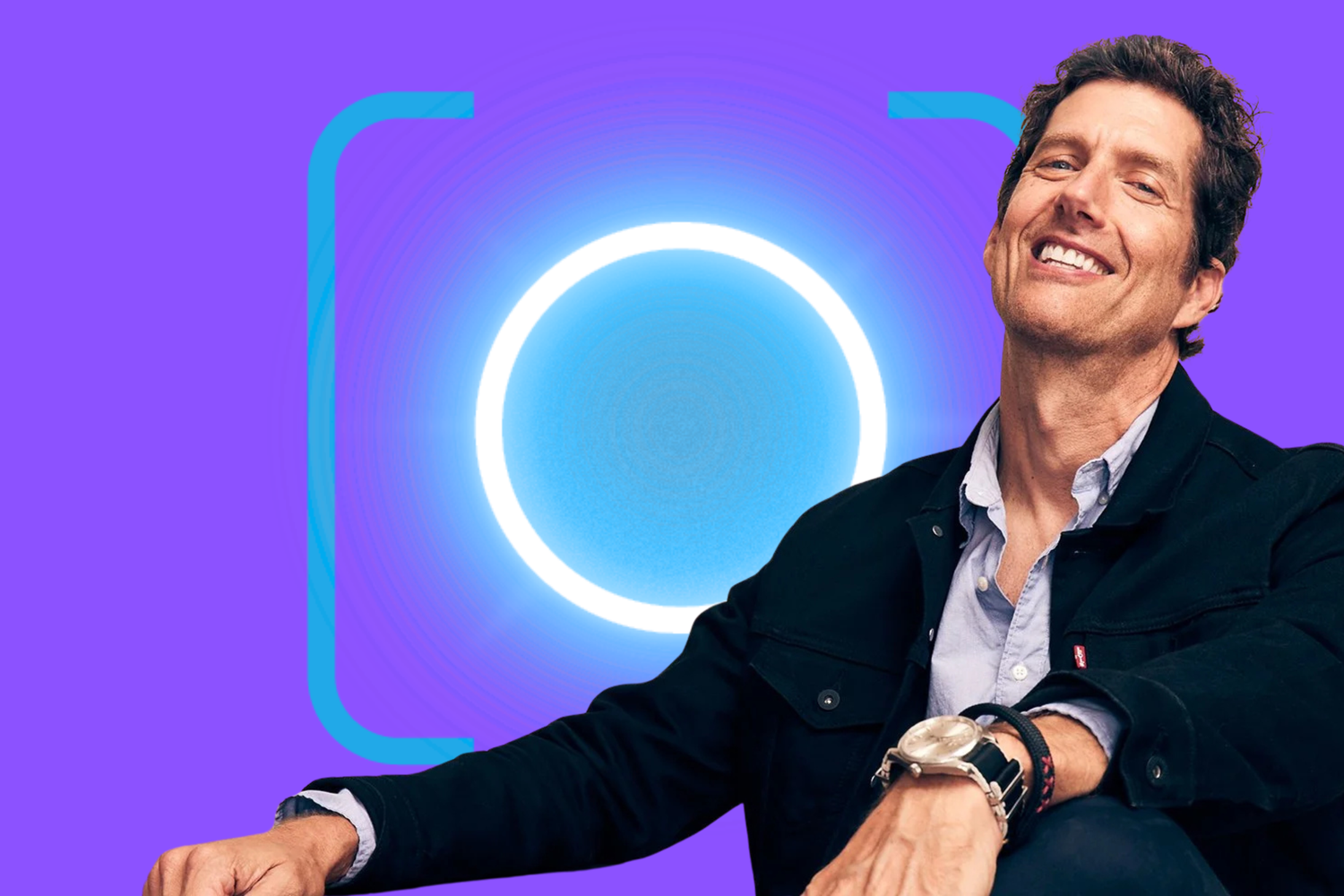
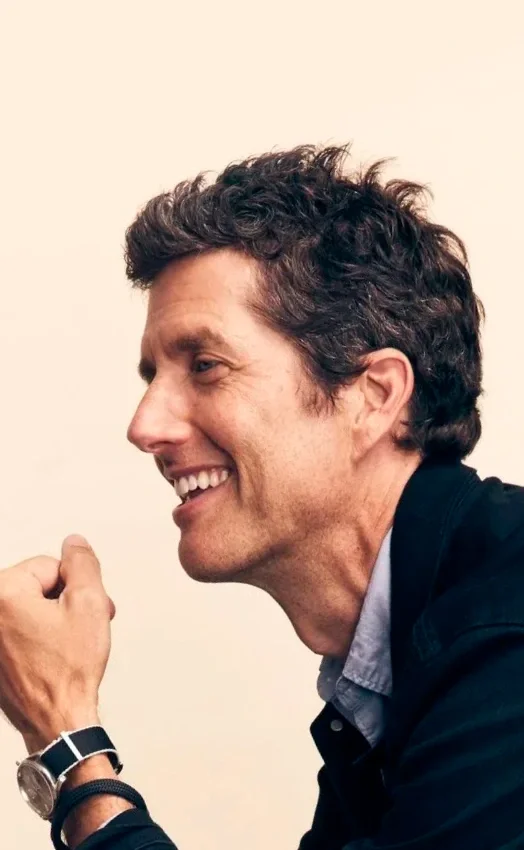
Source: Kevin Griffin
The Better Than Ezra frontman has lived through one industry disruption after another. Now he's become something rarer — an AI music ambassador willing to build the alternative.
Kevin Griffin had just stepped off a Grammy panel in Nashville — the topic, as it so often is now, was AI and songwriting — when Zinstrel caught up with him.
By his own account, the room had been full of fear.
Artists, writers, industry figures trying to read a shift that's already underway, unsure whether to fight it or absorb it.
Griffin, the frontman of rock band Better Than Ezra, keeps finding himself in those rooms. But unlike most people in them, he arrives with something to show.
He's been with his band since the late '80s and is still touring. He's a co-writer with credits spanning Meat Loaf to the present, a publisher, and the founder of the Pilgrimage Music Festival in Tennessee. Now he's one of the co-creators of AI-powered music-making platform Soundbreak.
That's what makes him a different kind of voice in this moment. He's not a skeptic or a booster; something closer to an ambassador. A working songwriter who has decided that the most useful thing he can do right now is build what he wishes already existed, and bring the industry along with him. When we spoke, he was characteristically direct about why he has entered the fray.
"I love being involved," he said. "I'm a songwriter, but I'm also a businessman. And I really like advocating for artists — selfishly, because I'm an artist."
Soundbreak, he says, is a bet that the music industry can get AI right, if the right people bother to try.
Before the Robots
Griffin has seen massive shifts in the music industry before. Better Than Ezra broke through in the mid-'90s — just a few years before Napster and file-sharing began dismantling the economics the label system had been built on.
Apple's iTunes offered a temporary stabilization, a way to sell songs legally at scale, but it was Spotify that revealed the real endgame: labels quietly negotiated equity stakes, the lawsuits were dropped, and songwriters were left out of the room entirely.
Griffin says artists' livelihoods were restructured without their input, the middle class of music writing hollowed out in the process.
When he and fellow songwriter Sam Hollander first explored Suno in 2024, his reaction, in his words, was blunt.
"Dude, it's f***ing game over."
But capability alone wasn't what struck him. It was the déjà vu he was feeling — the same IP vacuum, the same scramble, the same machinery spinning up around a technology that artists hadn't been consulted on and wouldn't benefit from.
He’d watched this negotiation before during the Napster era of the late 1990s, and he knew how it ended: with the industry eventually stabilizing around new platforms, while songwriters’ share of the value shrank.
"The labels sued… and songwriters got screwed. It eviscerated the middle class of songwriters. So I was like, this is that time all over again. If I don't get involved, I'm going to kick myself and I'm going to regret it."
Through his own research, he landed on a simple framing: AI predicts patterns. Songwriting, at its core, is pattern-based.
"People hear my music and they'll often say, did you write so-and-so's song?" Griffin said. "And I'm like, yeah, how'd you know? And they go, I could tell — when it hit the chorus, it sounded like one of your songs."
That was his aha moment. A model could learn that. The question was who would control what got built from it and whether songwriters would be at the table when it happened.
So he gathered some colleagues and started building.
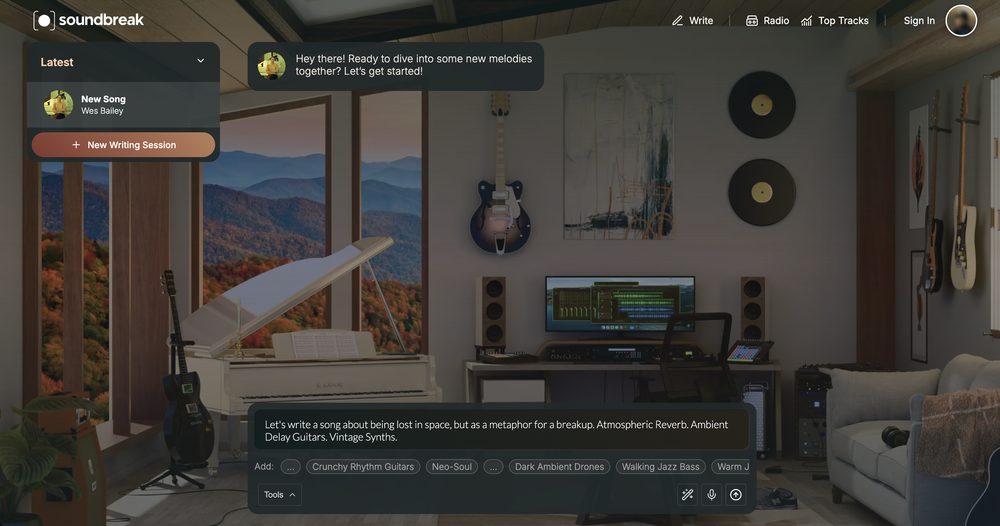
Screenshot from Marcus Lawrence’s Soundbreak songwriting session with Wes Bailey of Moon Taxi.
How Does Your Garden Grow
The impetus for starting Soundbreak was simple enough. When Griffin posed the question that would become Soundbreak's founding premise, it landed immediately with co-founder Shane Sniteman.
"If these AI platforms are gaining this much adoption,” Sneitman recalls Griffin asking, “how do artists and songwriters not get left behind?"
Sniteman leads digital at Gibson Guitars and previously built Strumn, a booking platform for venues and artists — someone who sits at the intersection of tech and music by both training and instinct. He was already primed for exactly this problem.
Sniteman brought the concept to engineer Barn Sweetman, previously co-founder of church management SaaS company Tithe.ly.
Sweetman did what he does: he started building and refining models. Within a few months, the first version of Soundbreak existed. It officially launched in February 2026, surprising the industry with a known songwriter visibly backing AI music.
The platform is built to be structurally different from the creative exclusion that scared Griffin in the first place. Where tools like Suno and Udio optimize for volume — type a prompt, receive a track — Soundbreak breaks from that paradigm.
After a free login, users land on Soundbreak's songwriter roster — browsable by name or filterable by genre, depending on whether you arrive with someone in mind or just a sound.
From there, a session opens: you can add your own lyrics, upload a reference track as a stylistic model, or describe what you're after: themes, instrumentation, feel. When the model generates, it's drawing from a fully licensed creative profile specific to that songwriter, not a generalized interpolation of the internet. The iteration layer is still developing; granular revision — isolating just the hook, just the bassline — is on the roadmap. For now, the craft is in the prompt.
Once a track is complete, the platform opens into distribution: sharing, download, stem export, radio submission, or full streaming rollout, depending on your account tier.
The core belief holding it all together, in Sniteman's view:
"If these AI music platforms are going to shape the next era of music, then they really should include the people who built the last one."
Deluxe
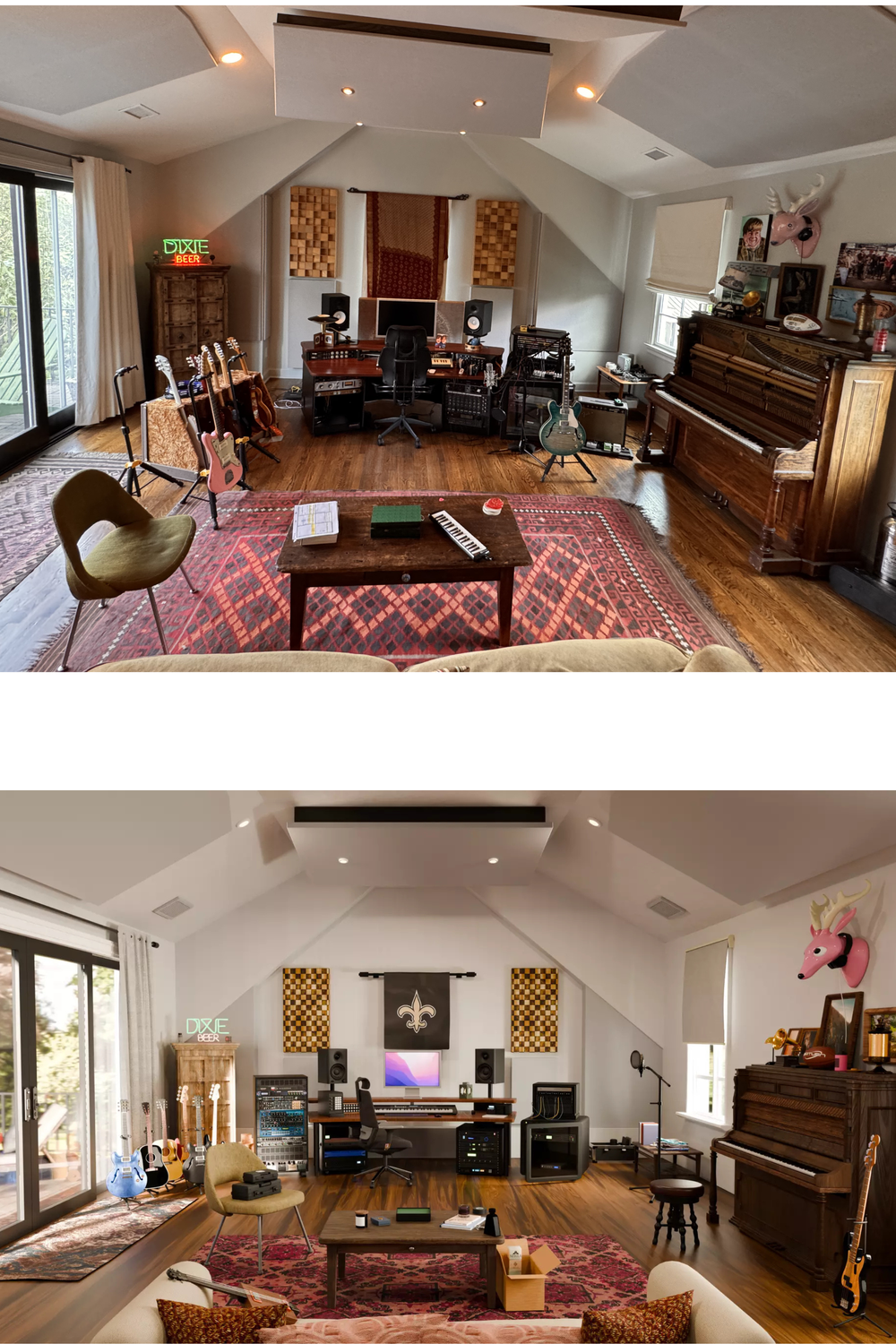
Top: Kevin Griffin’s real-life studio.
Bottom: The digital representation of that studio on Soundbreak.
The whole Soundbreak experience is architected to feel less like querying a system and more like sitting across from one of these songwriters in an actual session.
Besides each participating songwriter’s custom AI model trained on their licensed work and songwriting ethos, users encounter an immersive 3D studio environment shaped by their aesthetic.
Sam Hollander's Soundbreak studio, for instance, features a Neve console and a view of Fallingwater out the window — his specific request.
Griffin’s own Nashville studio is replicated down to the pink cartoon elk head mounted on the wall.
Rather than asking users to generate music into a void, the platform is inviting them into a creative space that actually belongs to someone.
Griffin said this layer was an important distinction for Soundbreak.
"Suno was so antiseptic and felt so techy; there was nothing artistic about it.”
Even the language inside each studio is calibrated to the artist.
"When you go into my studio or Max Frost's, we get a whole list: how do you start a session? What do you say? So the voice speaking to you is that artist's voice — and they don't say anything they wouldn't say."
The litmus test Griffin describes sounds almost too easy. You walk into his studio and say: write a song about my favorite pair of sneakers, call it "I Love My Chucks."
If the output sounds like a '90s-era Kevin Griffin song — not generically AI, not anyone else's — the model works.
"So far," he said, "we've been able to pass that test."
For artists who own their masters, unreleased recordings can be folded into the fine-tuning of the individual songwriting models — and Griffin told us the results have surprised even him.
"I hear those influences in the songs," he said of his unreleased records. "It blows me away."
But he said a collaborator offered a useful corrective: AI can only reference where you've been, not where you're going.
For example, Griffin's first Grammy nomination this year came for a bluegrass song. There's no bluegrass coded into the Kevin Griffin AI on Soundbreak.
The model captures the '90s rock version of him — real and recognizable — but not the whole arc.
A Soundbreak song generated with the model trained by
Moon Taxi keyboardist Wes Bailey.
Friction, Baby
The positioning doesn't resolve the larger debate, and Griffin wouldn't claim it does. But he brings a sharper historical lens to it than most.
In our conversation, he walked through the evolution unprompted: multitrack recording drew criticism for undermining live orchestras; Queen pressed "no synthesizers" onto their album sleeves right up until the record where synthesizers were all over it; Pro Tools and Logic transformed what it meant to record.
Each shift carried its own version of the same anxiety. Each one eventually reshaped the industry and kept moving.
"This is just another iteration of the evolution of music," he said. Then, almost without pausing: "All that said — we've got to advocate and do this right on behalf of the artists."
That tension is exactly where Soundbreak lives. The platform isn't trying to stop the AI wave. It's trying to decide who's on the right side of it when it lands. And Griffin is clear-eyed about the current reality.
"The big AI players right now have already trained on my music," he said. "They're using it. And Suno is a billion-dollar company."
But that doesn't mean they do a better job at capturing his unique aesthetic. His argument is that Spotify made the case that people will pay for stability and artist legitimacy even when a free illegal version exists.
He believes the same logic applies here.
The platform lets anyone start for free — full access to every AI artist, up to ten royalty-free tracks a month, and a daily submission to Soundbreak Radio. Paid tiers at $9 and $29 a month scale up the track limits and unlock distribution to Spotify, Apple Music, TikTok, and the rest.
The revenue split across all paid tiers favors the creative side: 50% to the creator, 25% to the artist whose model was used, and just 25% to Soundbreak — a structure that puts 75 cents of every dollar into the hands of the people actually making and inspiring the music.
"If you really want a more organic, real songwriting experience in this AI world, Soundbreak is the way to go," Griffin summarizes. "You're working with the artist in their world, you're supporting them, and you're connecting with them like you never have before."
Nearly 5,000 songs have been made on the platform since launch. The numbers are moving. So is Griffin.
Surprise
The clearest proof-of-concept for that belief is what Griffin is doing with his own band.
Through Soundbreak, he and bassist Tom Drummond are inviting fans to co-write the next Better Than Ezra single using the platform — submit to Soundbreak Radio, where the community can listen and upvote, with the most-surfaced tracks shared directly with the artists and featured in weekly recaps.
The fan-written song (marked with “BTE” in the title) that rises to the top gets recorded and released by the band. A real release. Shared credit. A co-write put out by a band with thirty-plus years of catalog behind it.
He was candid about why he was willing to put the band's name on it.
"I'm super protective of my band… but I believe so strongly about what we're doing that I didn't even hesitate," he said, noting that Drummond was equally enthusiastic.
The fan response since launch, he said, has validated that instinct: where he expected backlash, he found support.
"We're going to write a song with a fan and put it out together — and that's never been done. It's hard to be a band from the '90s and do something that's never been done before. And we're doing it."
That's the horizon he's building toward — a future where artists gain new income streams, new forms of fan connection, and actual control over how their creative DNA moves through AI systems. He envisions bigger artists eventually following the same path: a Dua Lipa, a Harry Styles, releasing a song written with a fan through a platform like this. "When that happens," he said, "the floodgates are going to open."
Soundbreak is small and early in its development. The questions around authorship and compensation in AI music haven't been settled by anyone, including Griffin.
But he's done sitting in rooms where other people decide what happens to songwriters. This time, he built the room.
To learn more, visit Soundbreak.ai.
