


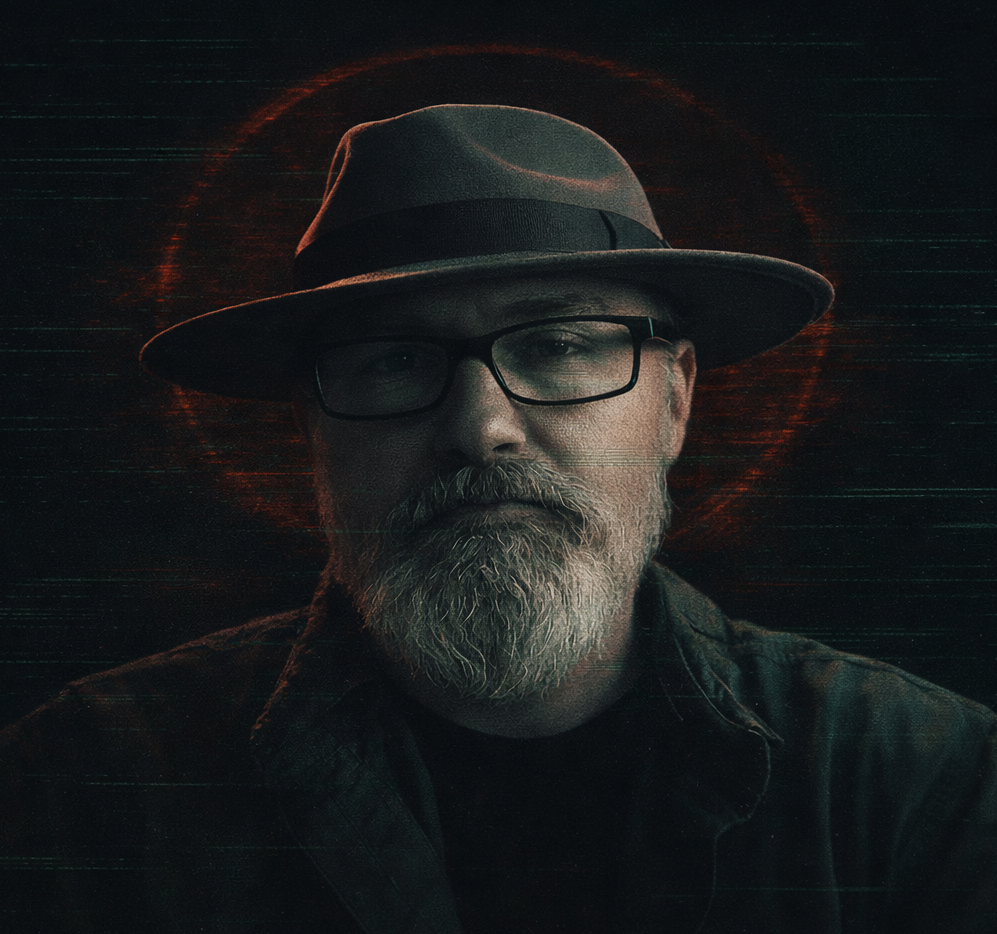
Illustration of Stonecool
There are regular livestreaming listening parties inside the AI:Underground community, and Stonecool is almost always there.
He's a pillar artist of the scene — not because his streaming numbers are massive, but because he's been there, consistently, since the early days. Discord threads, listening parties, the back-and-forth of a community figuring itself out in public. He's known.
What's less known, until you ask, is the rest of him.
His real name is John G. He's a merchandiser at a large corporation, and a self-described computer nerd.
"I'm not some larger-than-life character walking around all day," he says. "I spend a lot of time thinking, experimenting, figuring things out with games, books and music."
The name Stonecool itself comes from a character he made in a popular MMO. It's been his online identity for years.
Musically, he played bass in a garage punk band earlier in life. No conservatory. No decade of bands. No studio credits. Now, at age 55, he's developing a solid catalog of four albums and a reputation for musical excellence.
He has an instinct for structure, rhythm, and energy — how songs move and feel. And a working theory about how to use AI tools without being used by them.
"It clicked when I realized you could direct [song outputs], not just generate," he says. "Once I stopped treating it like a button and started treating it like something I could guide, it became real."
That's the move that produced everything else.

'Or Alternatively...'
The Ossia Project is what happened when that move became a doctrine.
Ossia is the Italian musical term meaning or alternatively — a passage in classical notation that can be played a different way. Stonecool took the term as a guiding principle for an entire creative framework. The manifesto he wrote is short and declarative.
Create without permission. Change without warning. Repeat nothing. Every track a new path. No genre loyalty. No fixed identity. Tools assist. Humans decide. Listeners interpret freely.
The project, in its own words, doesn't aim to be understood. It aims to remain alive.
"I realized repeating a 'sound' was starting to feel like maintenance instead of creation," he says. "Ossia came from wanting a space where I didn't have to protect anything."
His earlier albums, available on Spotify, sit in one lane. He says he could feel the cycle: a sound works, the expectation arises to keep doing it, creativity starts to bleed out. The manifesto is a rejection of that cycle. Repetition turns into identity, in his framing, and identity turns into limitation.
"If you get stuck in a rut," he says, "become free."
Stonecool · The Ossia ProjectHow it plays out
Living inside that framework means a specific kind of workflow.
Stonecool's songs usually start with a feeling or a direction rather than a full idea. He defines what the song should feel like, how it should move, how the vocal should be delivered. Then he builds structure and guides the generation.
The crucial part, he says, comes after.
"I'm not looking for a lucky output. I'm looking for something I can steer into place."
He refines, reshapes, sometimes redirects entirely. He doesn't accept a generation as finished. Most people, he says, generate something and move on. He treats that as a draft.
But — and this is where his approach diverges from a lot of careful AI music — he also doesn't over-refine.
"I love the opposite. Just let what comes out come out. Don't fight the output but work with it. Don't overdo it. Just let it come into being naturally."
The word naturally might strike some as bizarre when applied to AI generation.
The line between control and surprise is the working seam. Stonecool controls structure, delivery, and tone direction. He gets surprised by phrasing details, texture, unexpected moments that work better than planned.
The decision is when to keep the surprise and when to override it.
"The surprises are what makes parts of the entire process really special," he says. "The 'oh wow' moments."
That's his working answer to the slop question — the running argument about whether AI music is serious creative work or disposable generation.
His position is that the difference is intent.
"If something is generated and left as-is, it usually feels empty. If it's shaped, directed, and refined with a clear idea behind it, it feels different. People can tell the difference, even if they don't know why."
Shoes For Louie
Although Stonecool released an album introducing these principles straight to Soundcloud — called, appropriately, The Ossia Project — the clearest place to see all this framework in operation is the album that dropped on May 22 — The Album, by Shoes For Louie.
That isn't a separate project from The Ossia Project. It's what Ossia produces.
"Stonecool is me. Shoes For Louie is what happened to Stonecool," he says. "It wasn't planned. It just kinda happened."
The name itself comes from a memory: a homeless man named Louie that Stonecool once knew — dishevelled in every way except his sneakers, which he proudly kept immaculately clean.
"One of the nicest human beings I had ever met," Stonecool says. He hadn't thought about Louie in years. Then he did, and the name felt right.
"That's total Ossia in my opinion," he says.
That gets at the part of the manifesto that's hardest to pin down. Ossia doesn't actually demand chaos. It demands honesty about where the next thing comes from. A surfaced memory of a homeless man who took meticulous care of his shoes is, in this framework, a perfectly valid origin point for an entire artistic identity.
The project's only rule is that you let what's real become what's next.
The Album has been received warmly inside the AI:Underground ecosystem since release — and has been a proving ground for the framework's principles.
Take "Bloom Through Concrete," one of The Album's catchier tracks. Stonecool wrote it with a specific image in mind: a plant growing through a crack in a New York City sidewalk. Literal. Spatial. Almost photojournalistic.
A listener told him they heard it differently, taking it as a song about growing up, about coming into being.
"That's a huge compliment and a thought process from a listener that to me is brilliant. Total Ossia."
The Contradiction
But there's a contradiction at the center of the project.
During a recent AI:U listening party, the host — Doruk "Vikingur" Mezde — paid Stonecool what most artists would call the highest possible compliment. Stonecool's songs, Mezde said, are instantly recognizable now. He has a sonic identity.
But that's exactly the thing Ossia was built to refuse.
"It goes totally against the Ossia method of being unpredictable, not overly produced, and more free flow," he says. "So I have to admit Ossia has evolved in a sense."
But the evolution didn't break the framework. It just shifted which aspect of it was the most important: Tools assist. Humans decide.
That line has held. And it's the reason for the paradox.
If you commit hard enough to making your own decisions — what stays, what changes, what the final piece actually is — those decisions start to add up to a unique signature.
The fingerprint Mezde recognized didn't come from imitating a style. It came from the cumulative effect of a real person making thousands of small calls about texture, phrasing, and direction.
"The work is more from me now than ever," Stonecool says. "I make even more decisions, and work with the tools' inherent ability for great possibilities."
The signature people are starting to recognize isn't a sound. It's the shape of his judgment.
The bigger picture
There's an ongoing argument inside the AI music conversation about what separates disposable output ("slop") from real artistic work. The standard frames have been ethical, legal, technical: who owns the training data, how to label generated work, whether the audience can tell. Stonecool's framework offers a different cut at the same question.
To him, the line isn't whether you used AI. The line is whether you made intentional decisions.
"If you're not making those decisions, you're not really creating," he says. "You're selecting."
Creating versus selecting. That's the distinction Ossia is built to enforce, and the one Stonecool sees as the actual difference between intentional work and AI drift.
Otherwise, "AI will drift toward what works, what's common, what's familiar," he says. "If you don't push it, it will settle and become stale."
Anti-algorithm thinking, in his usage, is about resisting the gravitational pull of AI's averages. The tools want to make your work generic. The human's job is to push back.
What that opens up, in his telling, is something more interesting than either "AI music" or "real music."
"This isn't about replacing anything. It's about expanding what's possible. The goal isn't to make AI music. It is to make things that couldn't exist without this approach."
Create without permission. The manifesto's first line was always its conclusion.
