
A year ago, if you wanted to find the center of gravity in AI music, you'd have looked at a Discord server or a Suno leaderboard. More and more, you'd look at a competition bracket instead.
AI music song competitions — Eurovision knockoffs, blind livestream showdowns, Instagram tournaments, fan-run "editions" with their own Discord servers and final broadcasts — have quietly become the primary way the AI music community meets itself, sees itself, and recruits new members.
They're doing double duty as social infrastructure and as identity formation: a place where "I make AI music" becomes "I represent a country," or "I'm competing this weekend," which is a very different, much stickier kind of belonging.
As presented in our Map of AI Music Culture on the Creator Hub, below is a tour of the field as it stands right now — not exhaustive, but a real map of where the community's energy is going.
SSC
SSC's origin story is the whole thesis in miniature: it started as one person's small idea and grew into infrastructure. Finnish AI creator Ville "Wappie" Pesonen launched it in April 2024 as the Suno Song Contest — about 20 songs, no particular ambitions. Two years later it's running Eurovision-style community-voted seasons (its eighth wrapped in May) with a two-week submission window, one entry per person, strict no-campaigning voting rules, and real national representation. It's the closest thing the space has to a founding myth, and it's since become the platform other contests build on top of.
The AI Song Contest
The oldest and most institutional entrant, dating to 2020 when Dutch broadcaster VPRO staged it as a pandemic-era Eurovision substitute. It's since become an independently run nonprofit (Stichting AI Song Contest), pairing musicians with AI specialists for human–AI co-written songs judged by a mix of jury and public vote, capped by a live finale — Hilversum, then Liège twice, A Coruña, Zurich, Amsterdam, and now Bangkok in November 2026. Brazil's GENEALOGY took both the public and overall prize in 2025. It's arguably the version with the most technical innovation and the least tolerance for fully-generated entries — the point is the collaboration, not the automation.
EuroReVision
The most explicitly Eurovision-coded of the bunch. Entrants submit Suno tracks to represent countries and the public votes to crown a champion. There’s a contest that mirrors the Eurovision season, but the contest also has smaller, seasonal events, like the summer-focused “Heatwave 2026.”
Sunovision
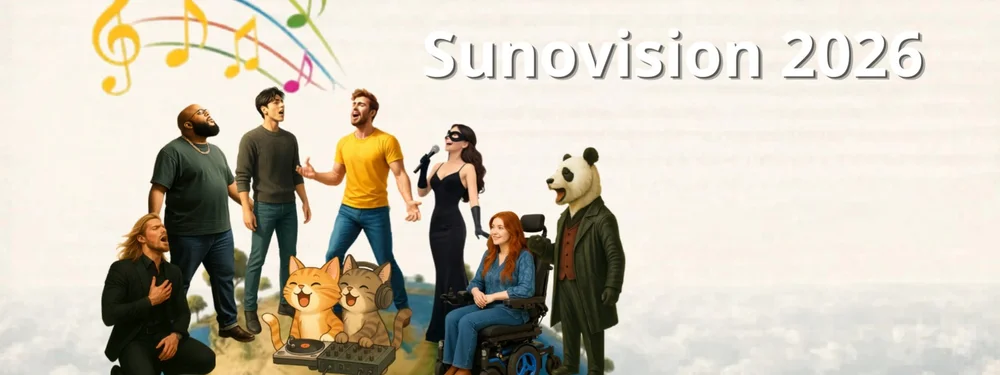
Not a sibling project under the SSC umbrella, but close enough to be mistaken for one — Sunovision runs on the same songcontest.ai platform and draws many of the same organizers and competitors, while standing as its own distinct contest. Its hook is blind, anonymous entries: creators compete without names attached, judged through a mix of livestreamed jury commentary and public ranking. It's a direct answer to the "is this just about clout" critique that follows AI music everywhere: strip the names, keep the songs.
FairoVision
One of the newer, web-first entrants, structured around a simple hook — one song per country, head-to-head, global. It accepted 400 songs in its first contest, with songs moving forward based on the fan vote, and heavier weighted industry jury member votes. The format itself (national representation, direct matchups) puts it squarely in the same Eurovision-adjacent lane as SSC and EuroReVision, suggesting the "represent your country" format has become the default template for new entrants rather than an original idea any one contest owns.
Mobvision
Now on its third edition and explicitly fan-run, Mobvision is the one that's gone furthest toward treating the contest like a real touring production — a Discord community, a live feed, national finals, and a physical home base at the Hotel Abendkrone in Vienna. It's a small but telling data point that the community isn't just competing online; some corners of it want a stage, a venue, and a place to actually show up.
AI.LOVE.JAZZ
AI.LOVE.JAZZ is the list’s genre-specific outlier, and the one with the most real-world staging of anyone on this list. Its inaugural event was held July 9–10, 2026 at Casino Barrière Montreux — timed to coincide with the actual Montreux Jazz Festival's 60th anniversary — it's a global open call for AI-generated jazz, soul, and funk, judged by a panel that includes producer MoneOnDaBeat (credits with Ne-Yo, Robin Thicke, and Wale) and five-time Grammy winner Oscar Gómez. The top 15 finalists don't just get streamed — they get performed live by a house band, with a gala closer from Latin-flamenco jazz act PATAX. It's the clearest example yet of a contest treating the "can a machine improvise" question as the whole point, not a footnote.
The Future Sound Awards
Backed by Fanvue and built on TwoShot and SoundCloud, this is the closest thing to a mainstream, brand-partnered play — explicitly pitched as "the Grammys of AI music" and fronted by a judging panel that includes Butterbro, producer of the first AI song to chart in Germany. Entrants must build tracks inside TwoShot Studio, and scores combine judge marks (vocals, lyrics, beat, authenticity) with SoundCloud listens. The $10,000 prize pool and corporate sponsor stack put it in a different category from the community-run contests around it — more industry showcase than grassroots ritual.
MetaMorph
Technically the odd one out here — MetaMorph is an AI film award that happens to include music categories (Music Video, Music Creation) inside a much broader slate covering animation, advertising, horror, comedy, and long-form. It's worth watching less as a song contest and more as a signal that AI music's competitive instinct is bleeding into adjacent creative disciplines rather than staying contained to standalone song contests.
SoundStage
Not a contest so much as a stage with a competition bolted on. SoundStage is fundamentally an artist-page platform for Suno creators — import tracks, build a bio, collect fan tips via PayPal or Venmo — with a "Competition" tab sitting alongside the showcase tools. It's a useful data point on where this is all heading: infrastructure-first platforms treating competition as a retention feature rather than the whole product.
WAV-R Social
A Norway-based music and radio app that folds AI creators into "beat battles" alongside live internet radio and playlists. It's smaller and less AI-specific than the others, but it's an example of competition format getting absorbed into general-purpose music social platforms rather than living on its own dedicated site.
AI Song Showdown
Instagram-native and genre-bracketed, running as a tournament account rather than a standalone platform. It's the most socially frictionless entry on this list — no sign-up, no submission portal, just competition content built for a feed — which makes it a useful bellwether for how far downstream into casual scrolling this culture has already traveled.
It’s Just the Beginning
From the AI music contest/community builder Vibya to the monthly Suno contests to the exploding number of smaller contests appearing at songcontest.ai, the listed contests above are just the tip of the iceberg. None of these contests compete for the same prize money or even the same audience, but they're all solving the same underlying problem: AI music doesn't have a stadium, a chart, or an award show that the whole scene agrees matters yet — so it's building a mass of small ones instead. That's a strength right now, because it means low barriers to entry and room for genuinely interesting formats like blind judging or Instagram brackets.
