
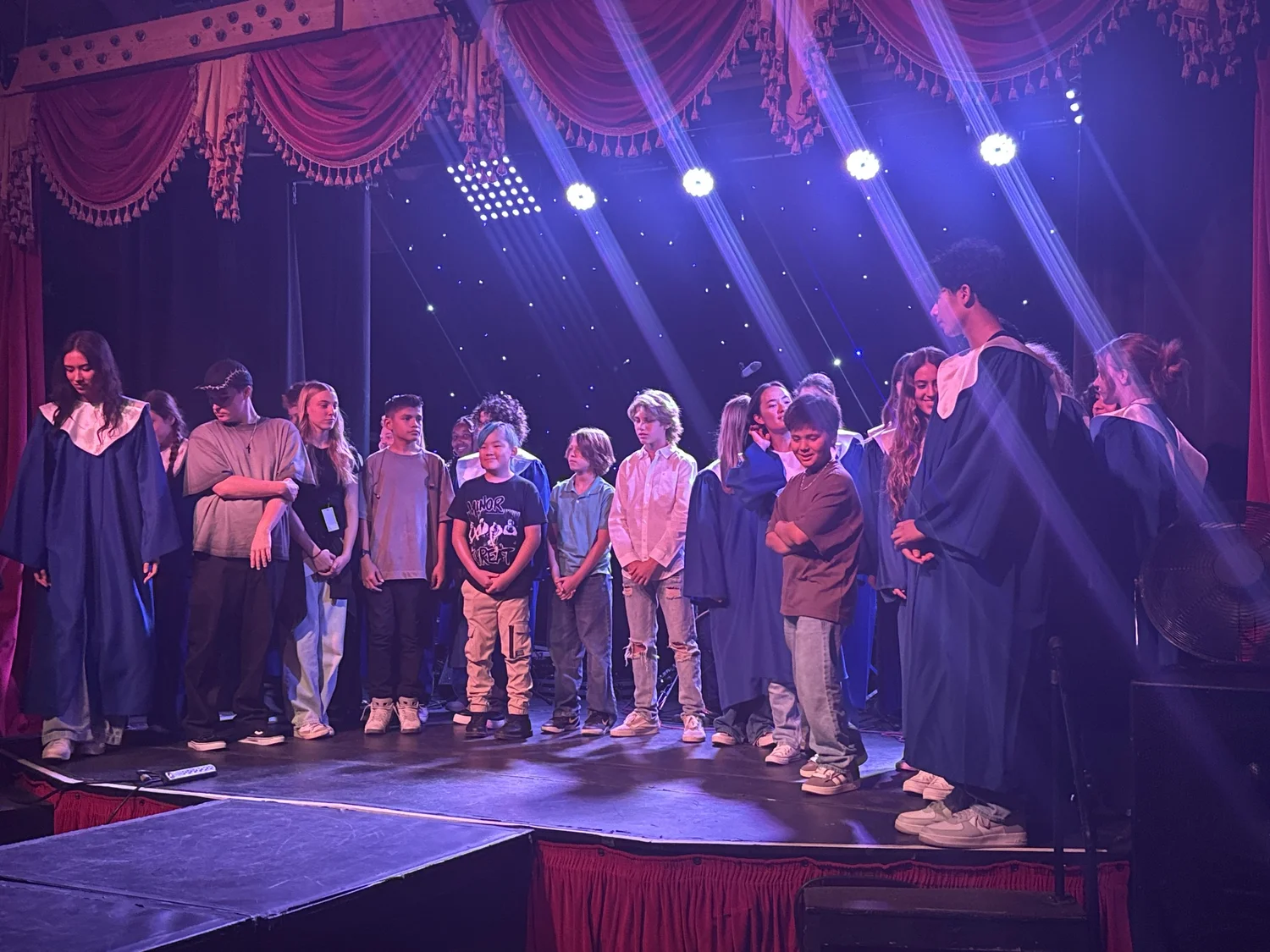
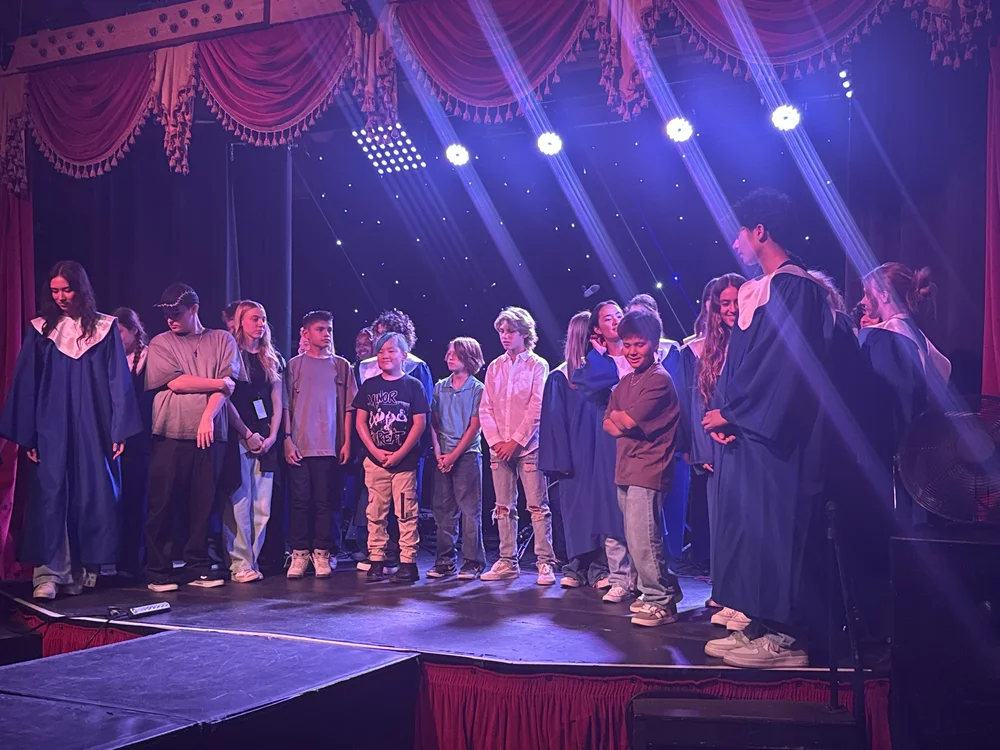
The curtain call at the end of the Chaisen Hale “Too Real” concert. At center, in white, is lead performer John Victor.
On a Wednesday night in Los Angeles, AI music stepped out of the interface and into something far more revealing: a room full of people watching it try to become human in real time.
Zinstrel was on the ground at Chaisen Hale’s “Too Real” concert — a hybrid performance built around an AI artist, a filmmaker’s vision, and a cast of human performers tasked with making it all believable. What unfolded wasn’t a tech demo. It wasn’t a gimmick. And it definitely wasn’t sterile.
It felt like a show.
A Concert Built Like a Film
From the start, it was clear this wasn’t structured like a typical live set. Creator Brian Gregory (whose background is in filmmaking) approached the night like a narrative experience.
The staging leaned cinematic. A preroll video introduced Chaisen in a desert landscape, setting tone before a single live note was played. The story anchored everything: a character recovering from a devastating car crash, trying to piece together identity, memory, and belonging.
That narrative throughline gave the music weight. It also gave the audience something rare in AI music right now: context.
Rather than a playlist of generated songs, this was a story unfolding across mediums: screen, stage, voice, and body.
The Human Layer Was the Point
Two performers carried the role of Chaisen Hale: John Victor and Oliver Stover. That decision alone said a lot. The Chaisen Hale project was never about replacing the human. It was about embodying something that doesn’t exist physically yet, and making it legible through people.
Victor’s performance was the emotional center of the night. At times he sang live. At other times he lip-synced to AI-generated vocals. The tension between those modes wasn’t hidden and it wasn’t perfect; it was human, and part of the experience.
One of the most striking moments came early: after a song, Victor placed his hand on his chest and looked down at it, as if recognizing his own physical form for the first time. It landed. Not because it was technically impressive, but because it was emotionally clear.
Later, during “Sing for Me,” backed by the Musyca Children’s Choir, the illusion held even through the seams. The audience understood what was happening, and chose to go with it.
That’s the shift. Not perfection: participation.
A Rock Show at Its Core
For all the conceptual framing, the night never lost its footing as a live music event.
The opening band, Zero Signal, set the tone immediately. They tore through Chaisen Hale songs with the kind of energy that makes the AI origin of the material almost irrelevant. Loud, tight, and fully committed, they proved something important: these songs can survive outside the model.
They can be interpreted. Translated. Played.
That matters more than whether they were generated.
Musyca added another layer, bringing scale and emotional lift to a key moment. Their presence also reinforced something that came up repeatedly throughout the night: this wasn’t a cold experiment. It felt communal. Family-driven. Grounded.
The Story Landed
As the set progressed, the narrative deepened. Lines like “I want to use my voice to lift people up” and “I get that I’m different. I just don’t want different to mean I can’t belong” didn’t feel like abstract AI musings. They felt targeted, almost too on-the-nose in a way that worked.
By the time a montage of Chaisen’s videos played near the end, culminating in a single word on screen — coexist — the emotional intent was clear. This was never about competition or replacement.
Coexistence.
A teased line — “In two weeks or so, I get my new body” — hinted at where this project is headed next. It’s evolving in public.
What This Night Actually Proved
When AI music leaves the interface, the rules change immediately. There’s no skipping. No regenerating. No hiding behind prompts. The music has to hold a room. The performers have to carry belief. The audience has to decide, in real time, whether it works.
And it did.
Not flawlessly. Not seamlessly. But convincingly enough to matter and connect.
Because what this concert showed is that AI music doesn’t need to replace anything to be culturally relevant. It just needs to function in the same spaces. Under the same pressure.
And the room didn’t reject it. It leaned in.
The Bigger Message
If you zoom out, the most important part of this night wasn’t the spectacle. It was the framing.
AI music is often discussed as a tool, a threat, or a novelty. Rarely is it treated as a medium that can support storytelling, performance, and emotional continuity across an entire evening.
This concert did that.
It also revealed something the broader industry is still struggling to see clearly: AI music is not just about generation. It’s about interpretation.
The model can produce the material. But it still takes humans to shape it into something that connects.
That’s where the real work is happening.
And increasingly, it’s happening in rooms like this one.
