
If you’re making music with AI right now, you’ve probably heard some version of this:
“If you pay for the tool, you own the song.”
That statement is… half true, which is why it causes so much confusion.
The real issue is that two very different ideas get lumped together:
monetization rights, and
copyright ownership.
They are not the same thing, and AI tools like Suno, beat generators, and AI plugins sit right in the middle of that confusion.
Let’s slow this down and get precise.
First: What the Law Actually Says
According to the U.S. Copyright Office’s report Copyright and Artificial Intelligence: Part 2 — Copyrightability, here’s the framework that applies today:
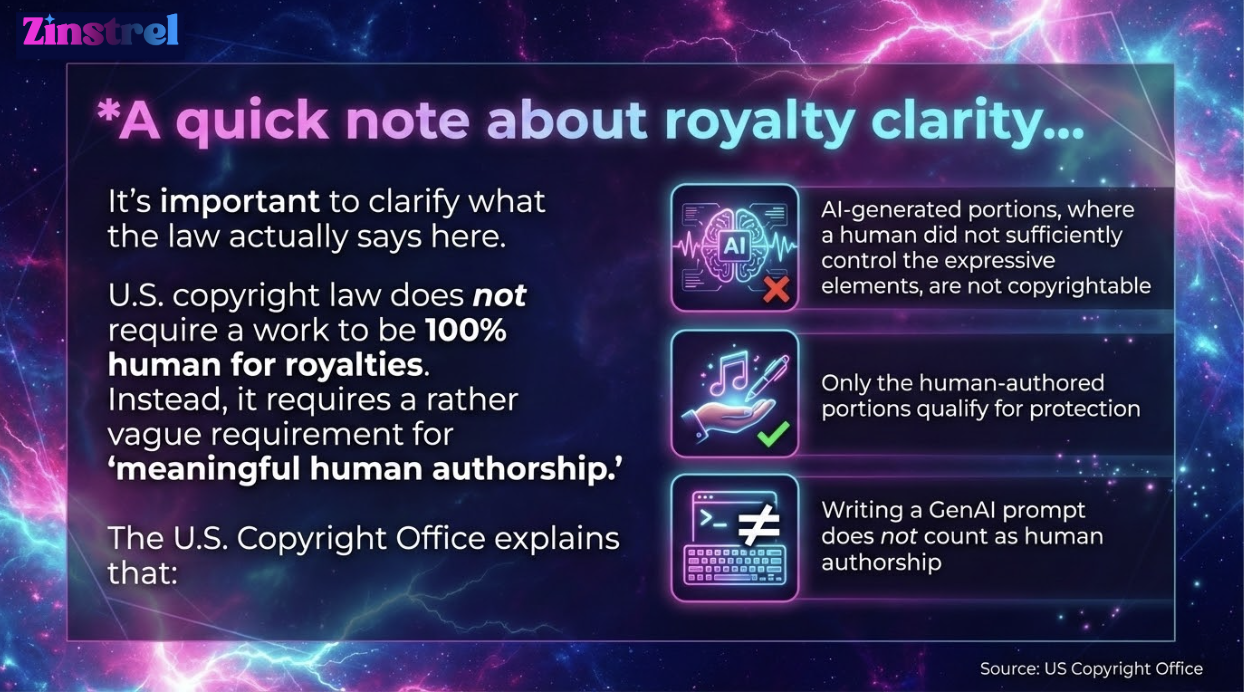
Copyright protects human authorship.
Material that is generated entirely by a machine, without sufficient human control over the expressive elements, is not eligible for copyright.Existing law already covers this.
The Office does not believe new AI-specific copyright rules are needed.Prompts are generally not authorship.
Providing prompts usually counts as giving instructions or ideas, not controlling the actual expression the system produces.Assistive vs. generative use matters.
If AI assists human creativity, the result may be copyrightable.
If AI determines the expressive elements (melody, lyrics, vocals, arrangement), the output itself is not.Human contributions can still be protected.
Lyrics you write, vocals you perform, melodies you compose, arrangements you create, and significant edits you make can all qualify for copyright.Every situation is evaluated case by case.
There is no percentage rule or checklist that guarantees protection.
That’s the legal ground everyone is standing on , regardless of tool. Now that we got the legalese out of the way, here’s what that means…
AI Music Generators (with Suno as the Clearest Example)
Tools like Suno can generate complete songs: music, lyrics, vocals, structure… the whole thing. Because of that, they’re where ownership questions show up most often.
What Suno Actually Gives You
On paid tiers, Suno says it assigns to you all of its rights in the output you generate during your subscription. That’s important, but it’s also limited.
Suno also makes a key clarification: it does not guarantee that any copyright will result from that output.
Here’s the part many creators miss:
Being allowed to monetize a song is not the same thing as owning the copyright.
Monetization = Suno allows you to upload, distribute, and earn money from the track.
Copyright = the government recognizes the work as protected human authorship.
Suno can grant monetization rights, but it can’t override copyright law.
In summary, if Suno generated the melody, lyrics, vocals, and arrangement, and your role was prompting, the song may be monetizable under Suno’s terms, but it is not automatically copyrightable under U.S. law.
That’s not a Suno-specific problem. That’s how copyright works.
What can still be yours
Even when using Suno, you may claim copyright in:
lyrics you personally wrote,
vocals you personally recorded,
melodies you independently composed,
arrangements or edits you meaningfully created.
The AI-generated portions themselves remain unprotected.
Beat Generators and Instrumental AI Tools
Now let’s talk about a different category of tools — ones that generate beats, instrumentals, and stems meant to be edited.
These tools often fit much more naturally into copyrightable workflows.
Why? Because the human usually controls what happens next.
When you import an AI-generated beat into a DAW, rearrange it, write your own melody and lyrics, record vocals, and/or make creative structural decisions, you’re no longer presenting the AI output as the finished work. You’re using it as raw material.
Under existing law:
the raw AI-generated beat may not be protected by itself,
but the human-authored song built on top of it may be.
The Copyright Office explicitly recognizes protection for human selection, coordination, arrangement, and modification of AI-generated material.
This is why beat-oriented AI tools often feel less legally ambiguous than full song generators.
AI Plugins Inside a DAW
AI plugins are another important category.
These tools might suggest harmonies, generate MIDI based on what you play, enhance audio, or respond dynamically to human input.
In these cases, the AI isn’t acting as an autonomous creator. It’s functioning more like an instrument or assistant.
When the human is:
choosing notes,
shaping performances,
deciding structure,
the expressive control remains human.
Under the Copyright Office’s framework, this aligns much more closely with assistive AI, not generative replacement… which makes copyright protection far more likely.
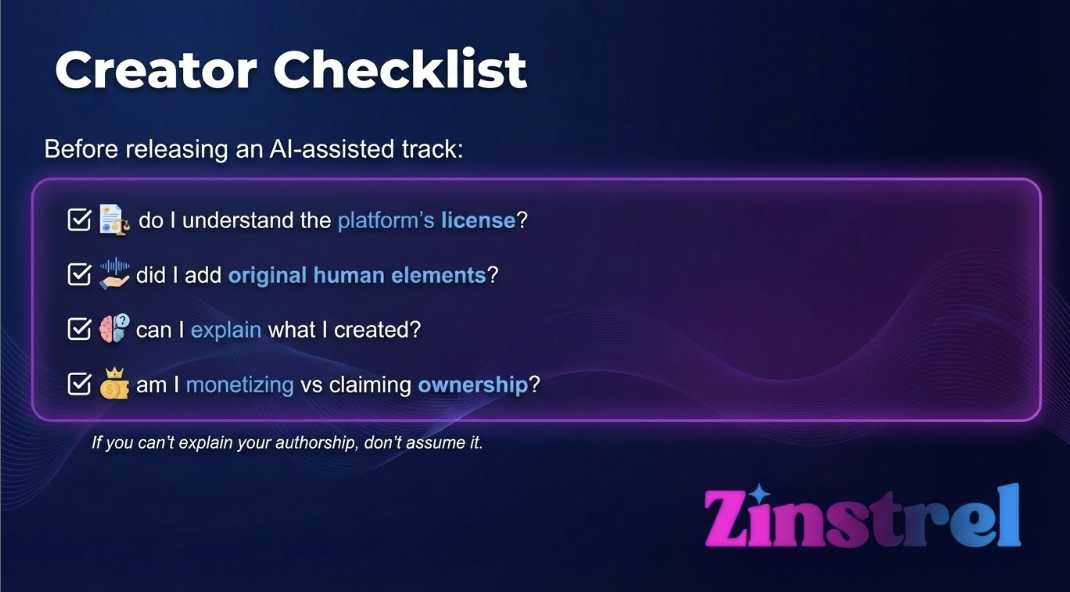
So what does this actually mean for creators?
Here’s the cleanest way to think about it:
AI can give you permission to use music.
Only human creativity creates copyright.
That means:
You can legally release and monetize AI-assisted music if the platform allows it.
You cannot rely on copyright protection unless you add meaningful human authorship.
Hybrid workflows are not “unsafe” — they’re normal — but protection applies only to the human-made parts.
Beat tools and plugins often integrate more cleanly into copyrightable workflows than full song generators.