Producer.ai Is Now Part of Google, and Now Lyria Hits Primetime
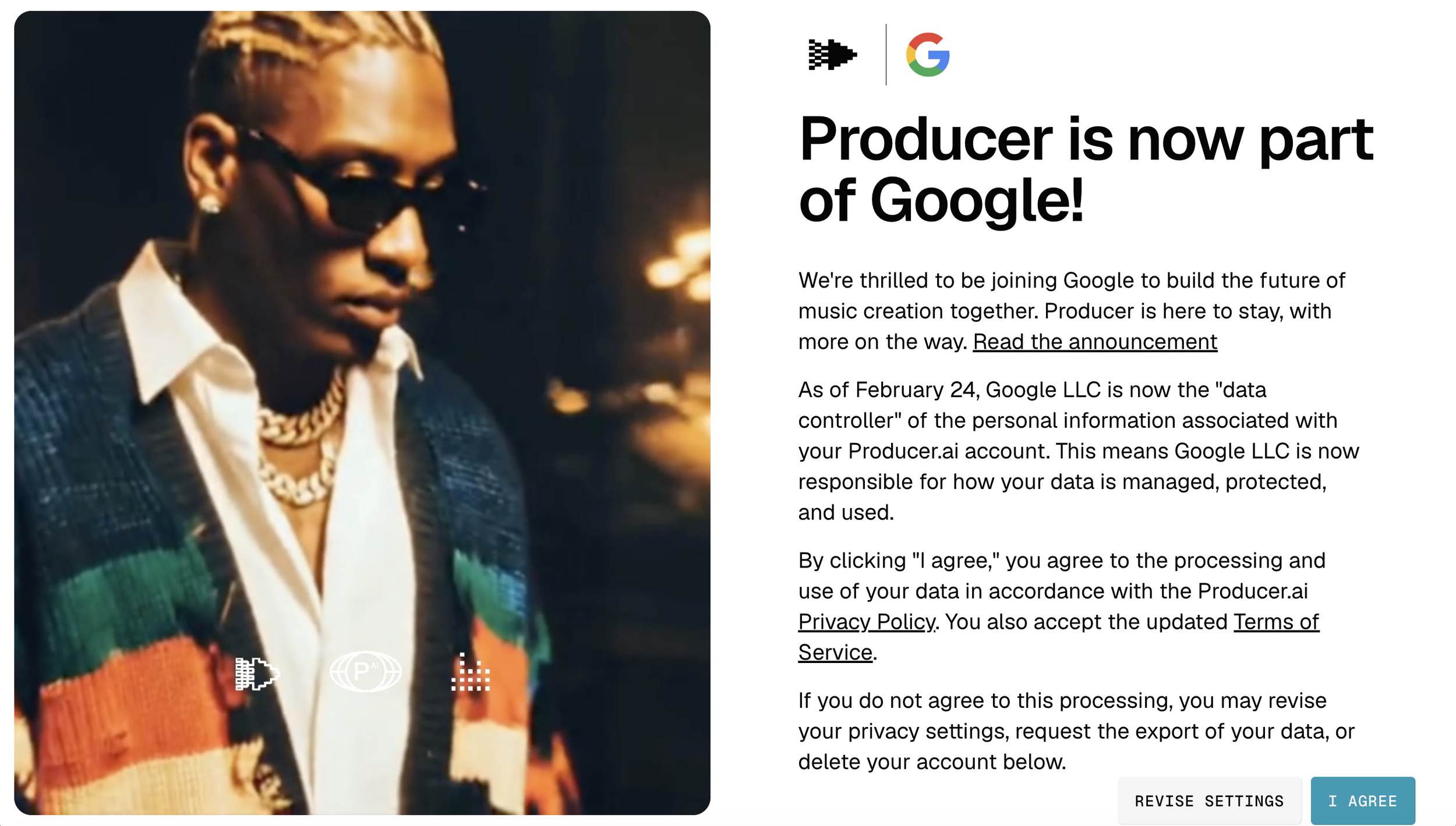
Just before 10 a.m. Eastern on Feb. 24, the Producer.ai Discord lit up with a surprise announcement: Producer is now part of Google. Hours later, the Producer.ai homepage echoed it in banner form:
Source: Producer.ai
Producer is now part of Google! Create the music you imagine.
We’re thrilled to be joining Google to build the future of music creation together. Producer is here to stay, with more on the way.
That means Lyria, the new Google AI music software that made headlines last week as it entered the Gemini ecosystem, has quickly ascended from a 30-second novelty to a major player in the AI music sphere. Gravity has shifted.
And this isn’t just about Lyria.
In Google’s official announcement, Producer is positioned inside Google Labs, powered by Google DeepMind’s Lyria 3, alongside Gemini and even Veo — Google’s generative video model. All outputs are embedded with SynthID, Google’s imperceptible watermark for identifying AI-generated content.
We’re talking full-stack integration now.
A Shift Years in the Making
Tuesday’s announcement is the culmination of a multi-year arc. Producer.ai traces back to Riffusion, which raised a $4 million seed round in 2023 led by Greycroft, catapulting a spectrogram-based music experiment into a structured platform. Greycroft has a history of backing startups that later feed into big-tech acquisitions — particularly by Google — so today’s integration fits a familiar venture-to-platform pipeline.
Lyria 3 — Google’s newest generative music model — had already surfaced inside Gemini, allowing users to enjoy Producer-like iterations in making short audio clips. The launch generated a new wave of interest and horror among industry watchers. What it offered was solid, but limited: 30-second clips that felt more like research demos than creative tools.
Inside Producer, Lyria 3 preview replaces the just-released interim FUZZ model and generates tracks up to three minutes long, wrapped in a workflow built for meaningful iteration rather than novelty snippets.
Lyria proved its concept within Gemini. Now it’s prepped for primetime as the engine behind the new version of Producer.
Google’s announcement also emphasizes “creative control,” including future-facing tools like Spaces, which allow artists to generate instruments and effects through natural language and modular-style environments.
Combined with DeepMind’s stack and watermarking infrastructure, Producer is now institutionalized, rather than experimental.
Reaction: Realism Over Hype
The Producer Discord reaction was measured, mixing creator excitement with structural nervousness. Many users didn’t erupt with cheer, but after the tumultuous past week — which involved seeing Producer.ai abruptly tell users to download anything they wanted to keep, experiencing Producer being shut down for a day, and come back with improved instrumentals but bizarrely remedial vocal generations — there was recognition of tangible quality improvements in the current model phase. The sentiment was grounded in early sound generations, not press copy.
One member summed up the optimistic vibe on outputs directly: “Literally prod ai make bangers now 💥💥.”
Other users said they eagerly anticipate future models that will be built on wider datasets.
At the same time, skepticism hovered around communication and control. Some pointed to Google’s legacy of sunsetting products and worried about what consolidation means for an independent creative community.
What Actually Changes: The Fine Print
Yes, Lyria inside Producer now generates tracks up to ~3 minutes — not the 30-second clips you get inside Gemini. But the more durable shift is contractual.
As of February 24, Google LLC is now the data controller. That means your account data and generated content sit inside Google’s legal and privacy framework — including updated Terms that redefine how users’ work can be reused.
Like Suno, you don’t receive traditional master ownership. You get commercial rights.
But Producer grants Google a perpetual, royalty-free license back to your content — meaning they can use outputs for platform operations, promotional purposes, watermarking infrastructure, or model improvement. You can sell your track. Google can still leverage it.
And because all outputs are embedded with SynthID, every track generated is permanently machine-identifiable within Google’s authenticity system.
This isn’t Wild West AI anymore. It’s compliance-forward infrastructure, with watermarking embedded at creation.
Google may have arrived later to generative music, but it’s entering with control: model, interface, and authenticity layer in one stack.
The New Normal for AI Music
Producer’s integration under Google Labs and DeepMind research turns what was once a research curiosity into a structured creative environment. The most advanced Google music model isn’t behind an API or a demo toy anymore — it’s embedded in a formidable, competitive, creator-facing tool.
The story here isn’t just better outputs for some AI music generator.
It’s watermarking, new terms, new data governance, and direct integration into one of the largest AI ecosystems on earth. It’s a structural shift that realigns who controls the tools, the data, and the future of AI music creation.